By late August the verdict is nearly always the same: rough lengths, dulled colour, frayed ends, a curl pattern that no longer holds. The sun has done its work. Here is how to recover — methodically, over four weeks.
We devoted an entire article to protecting your curls through the summer. But the season isn't decided upstream alone: what you do in September determines the state of your hair all the way into winter. A fibre left as it is after three months of exposure does not recover on its own. It keeps degrading, breaks more, and come November you find yourself cutting off five centimetres you could have saved.
What the sun actually damaged
We casually say "dried-out hair", as though water were the only thing missing. The reality is more precise — and more useful to know, because it dictates the care required.
The cuticle has lifted
This is the visible damage. The scales covering the hair, normally laid flat like roof tiles, have opened under the combined effect of UV, salt and heat. A hair with a lifted cuticle catches light instead of reflecting it: that is exactly what produces the dull appearance. It also tangles more, rubs against its neighbours, and breaks.
Internal lipids have melted away
Hair naturally contains lipids — a fatty cement that holds the fibre together and retains water. UV and hot water dissolve part of it. That loss, more than dehydration itself, explains the straw-like feel: the hair no longer has what it takes to hold on to whatever you give it.
Porosity has climbed
A direct consequence of the first two: your hair probably no longer has the same porosity it had in June. Medium-porosity hair in spring can find itself in the high-porosity range by late August — drinking everything, very fast, and releasing it just as quickly. This is the most important point in this article: if your routine has stopped working, it isn't that the routine went bad. It's that the hair changed.
Diagnosis in three signs
Before treating, observe. Three checks, five minutes.
- The elasticity test. Take a wet strand and stretch it gently. Healthy hair lengthens a little and springs back. Weakened hair snaps cleanly with no resistance, or stretches limply without recovering its shape.
- Roots-to-ends touch. Run a length between two fingers, top to bottom. If you feel a clear break in texture mid-length — smooth above, rough below — the lengths have taken the damage and the roots are healthy.
- Drying behaviour. Hair that dries far faster than it used to, in a matter of tens of minutes, signals porosity that has shot up.
An honest note that few brands make: damaged hair does not "repair" itself in the biological sense. It is no longer living once it leaves the scalp. What good care does is fill the gaps in the cuticle, restore the lipids that were lost, and sheathe the fibre so it regains its suppleness, its feel and its light. The result is real, visible and lasting as long as the care is maintained — but it rests on replenishment, not resurrection.
The four-week protocol
Week 1 — start from a clean base
After three months of sunscreen, salt, chlorine and leave-in applied on the beach, the fibre carries a build-up of residue. Those deposits act as a screen: as long as they are there, nourishing treatments sit on the surface and achieve nothing.
So begin with a careful wash — two passes of Hydra Curl rather than one, the first to dissolve residue, the second to genuinely cleanse the scalp. Sulphate-free, it removes that layer without stripping an already fragile fibre. Massage the scalp with your fingertips, never with nails. Rinse thoroughly, in lukewarm water.
Weeks 2 and 3 — deep replenishment
This is the heart of the protocol. Across these two weeks, move to two masks per week — a rhythm you wouldn't keep all year, but exactly what a lipid-depleted fibre needs to rebuild itself.
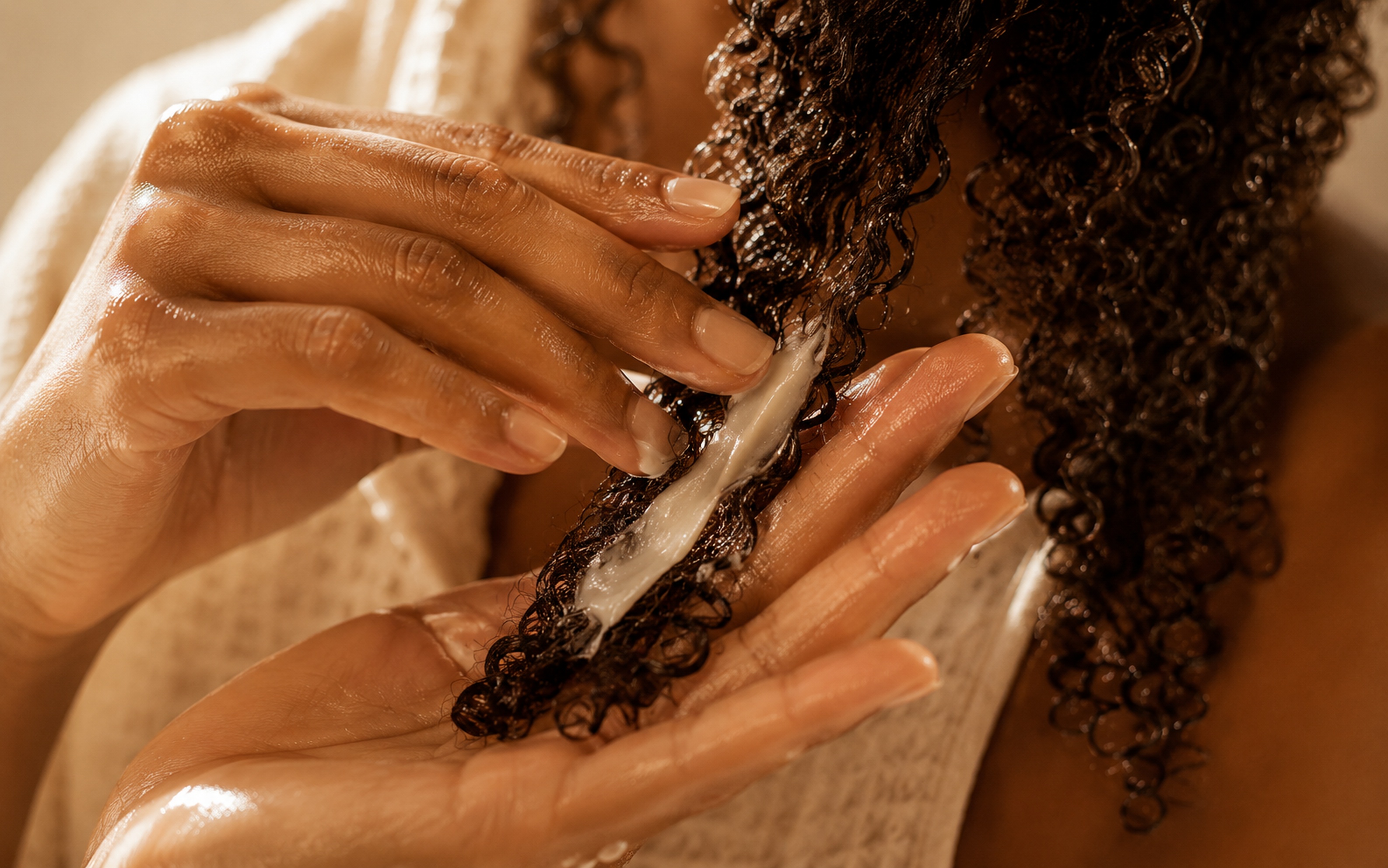
Nutri Curl was formulated for this precise moment. Kokum Butter fills the gaps in the cuticle and closes the scales; Baobab Oil, rich in fatty acids, restores the lost lipid cement; Castor Oil seals the whole and gives back body to the touch.
Three application details that change the result:
- Apply to squeezed-out hair, not dripping hair. A fibre saturated with water has no room left for actives. Press gently in a microfibre towel before applying.
- Leave it under a source of heat. A warm towel or a cap, 15 to 20 minutes. Heat opens the cuticle and lets the fatty compounds penetrate instead of sitting on the surface.
- Rinse with cool water. The most underrated gesture in hair care: cold water tightens the cuticle and locks in what you have just delivered. It is also what produces the shine.
Week 4 — stabilise
The hard part is done. Drop back to one weekly mask and let Condi Curl take over day to day: applied to damp hair after washing, it maintains the hydration delivered by the mask and stops the fibre emptying itself again between treatments. On dry hair, between washes, it revives the curl and restores the definition that had been lost.
The ETHNEIA after-sun protocol
Hydra Curl to clear the fibre without stripping it. Nutri Curl, twice a week for two weeks, to restore lipids and close the cuticle. Condi Curl daily to hold the result over time. The three-step ritual, simply intensified for the duration of the rebuild.
Should you cut?
Often, yes — but less than you think. A genuinely split end will not reseal: it keeps travelling up the fibre and ends up damaging healthy length. Better to remove it.
That said, there is no need to sacrifice ten centimetres as a precaution. Do the protocol first, cut afterwards: after four weeks, much of what looked dead in August will have regained suppleness, and your stylist will only take off what is truly lost. One or two centimetres is usually enough.
Three mistakes that slow recovery
- Stacking protein treatments. On hair already stiffened by the sun, an excess of protein produces the opposite of the intended effect: the fibre turns brittle and dry to the touch. What is missing at the end of summer is lipids first.
- Going back to heat too soon. A scorching dryer and a flat iron on an open cuticle means adding one assault to another. Let hair air-dry through the rebuilding month, or use a diffuser on a low setting.
- Washing more often because "it gets greasy". A scalp producing more sebum in September is responding precisely to the drying it went through over summer. Multiplying shampoos keeps the cycle going. Space them out, nourish the lengths, and balance returns on its own.
And afterwards
At the end of the fourth week, redo the porosity test. You will often find it has come back down — a sign the cuticle has closed again. That is the moment to adjust your autumn routine: weekly mask, daily leave-in, and the particular attention that changes of season call for.
The end of summer is not a penalty. It is simply the point in the year when textured hair asks for the most — and when the care you give shows fastest. Four weeks of attention are enough to undo three months of sun.
Nutri Curl, the repairing mask at the heart of the protocol.
Discover the product